
Electrical Installation Certificate (EIC): A Complete Guide for UK Electricians
From 15th October 2026, every electrical installation certificate you issue for new work has to be certified to BS 7671:2018+A4:2026. The previous version was withdrawn on that date, together with Corrigendum 2023.
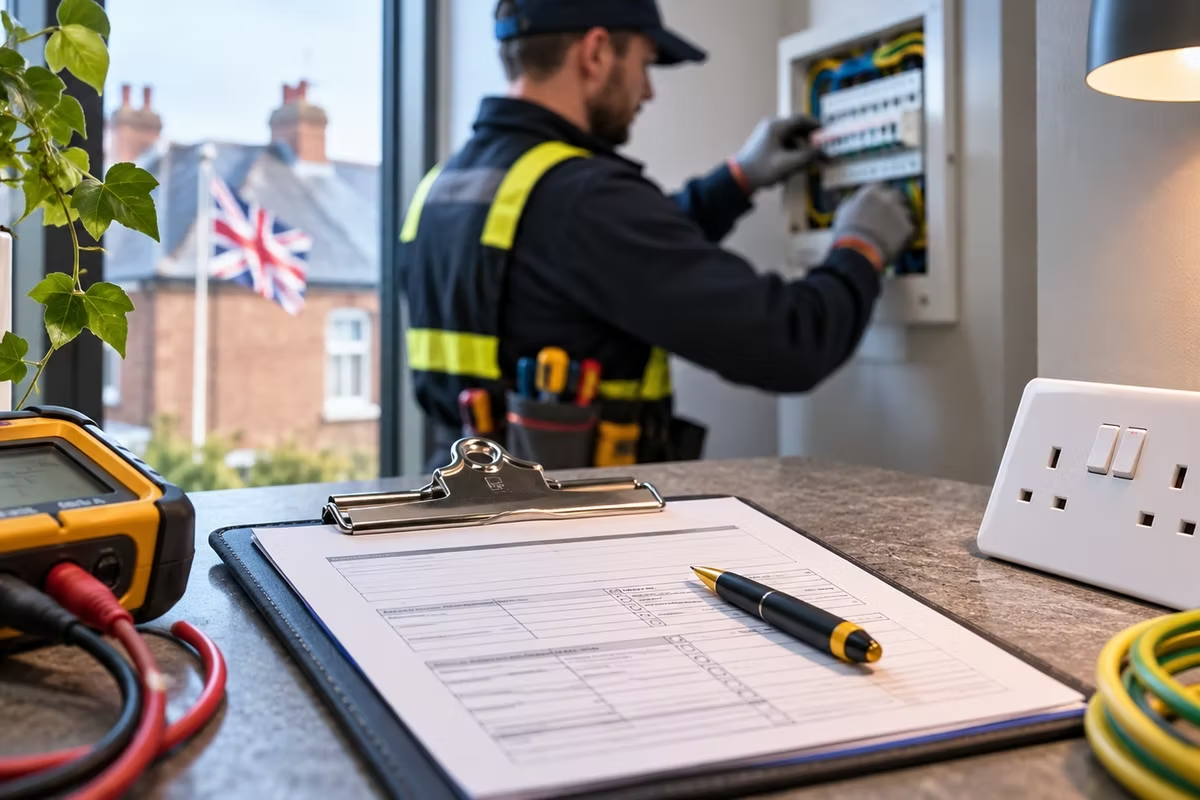
The vast majority of the EIC guidance that's still online was written prior to April 2026. It's all based on a standard that no longer applies.
This guide covers what the certificate is and which jobs are covered by it rather than a Minor Works Certificate or an EICR. It also covers what changed under Amendment 4, who can sign, and how Part P notification sits alongside it. The standard is still the authority, so you'll need to check anything on the borderline against your copy and your scheme provider.
What an Electrical Installation Certificate Is
An EIC is the document which certifies that new electrical work has been designed, built, inspected and tested in accordance with BS 7671. It is the document which confirms initial verification: the first time an installation (or a new part of an installation) is signed off as being safe to use.
The model form is in Appendix 6 of the standard, and the IET publishes it along with the other model forms for certification and reporting.
Three things an EIC is not:
- A condition report. An EICR looks at an installation that's already there. An EIC certifies work that you've just carried out.
- A guarantee. The declaration covers reasonable skill and care, to the best of the signatory's knowledge and belief, for the work described.
- Proof of Part P notification. Notification is separate, and the Building Regulations compliance certificate is a different document.
EIC, Minor Works or EICR: Which Certificate the Job Needs
Picking the wrong form is the most common certification error, and the test is simple. Ask whether the job adds a new circuit.
Consumer unit and distribution board replacements need an EIC, not a Minor Works Certificate. A Minor Works Certificate can cover replacing an accessory or a luminaire, but not a distribution board.
An EICR never covers new work. Additions and alterations are new work, however small.
What Changed Under BS 7671:2018+A4:2026
Amendment 4 was published on 15 April 2026 and became the only current edition on 15 October 2026. Several changes touch certification directly.
- The edition on the declaration. New certificates reference BS 7671: 2026. Work certificated to Amendment 3 references BS 7671: 2024.
- PNB as an earthing arrangement. Section F now separates TN-C-S (PME) from TN-C-S (PNB). Protective neutral bonding appears in the standard for the first time.
- Minor Works test notation. End-to-end resistance tests are recorded as r1-r1, rn-rn and r2-r2, replacing the older L/L, N/N and cpc/cpc.
- EICR outcomes. Observations are split into two parts, and C3 and FI codes no longer make the overall outcome unsatisfactory on their own.
- Medical locations. Section 710 was heavily revised, with a new schedule for recording supplementary bonding conductor resistance.
- Scheme form references. On NOCS, form reference 18.4 indicates Amendment 4 and 18.3 indicates Amendment 3.
Work designed before 15 October can still be completed and certificated to the edition it was designed against. NICEIC advises telling the client when a design follows a withdrawn standard.
Each project should use one edition from start to finish. Handwritten and electronic certificates both remain valid. NICEIC's Amendment 4 guidance sets out the transition in full.
What Goes on an EIC, Section by Section
The model form runs from Section A to Section J. Knowing what belongs where saves arguments later.
- A. Details of the client. Who ordered the work.
- B. Installation details. Address, description, and extent of the installation covered, any departures from BS 7671, permitted exceptions under Regulation 411.3.3, and the three declarations.
- C. Certification signatories. Design, construction, and inspection and testing.
- D. Next inspection. The recommended maximum interval before further inspection and testing, plus earth electrode details.
- E. Particulars of signatories. Names, addresses and contact details for the people who signed Section C.
- F. Supply characteristics and earthing arrangements. Earthing system, live conductor arrangement, nominal voltage and frequency, prospective fault current, Ze, and the supply protective device.
- G. Particulars of the installation. Means of earthing, maximum demand, earth electrode, main protective bonding conductors and the main switch.
- H. Schedule of inspections. Each item is recorded as acceptable or not applicable. There are no observation codes on an EIC.
- I. Comments on the existing installation. Where the work connects to something already in place.
- J. Schedules. Circuit details and test results.
The schedules are part of the certificate. An EIC issued without the Schedule of Inspections and the Schedule of Circuit Details and Test Results is incomplete, and a scheme assessor or a conveyancing solicitor will say so.
Departures, Limitations and Permitted Exceptions
Section B carries three fields that electricians often leave blank, and each one protects you.
Departures from BS 7671. Where the installation does not follow the standard, record the departure and the reason. An unrecorded departure reads as an oversight. A recorded one reads as a decision.
Permitted exceptions. Regulation 411.3.3 allows specific exceptions to additional protection by 30 mA RCD. If you rely on one, state it. Do not leave an assessor to work out why the protection is absent.
Extent and limitations. Describe exactly what the certificate covers. On a partial rewire or a single new circuit, say which parts of the installation were inspected and tested and which were not.
These fields decide how far your liability reaches. Loose wording widens it.
Who Can Sign an Electrical Installation Certificate
The standard EIC carries three signatory roles. Design, construction, and inspection and testing are each signed separately, because each covers a different responsibility.
Where design responsibility is shared, the form provides for Designer No. 1 and Designer No. 2. Amendment 4 keeps this structure.
A single-signature version exists for the common case where one person carried out all three roles. Sole traders and small firms use it for rewires and consumer unit replacements.
Signing is a statement of liability, not an administrative step.
Each declaration limits the signatory to the work described in the certificate, which is why the extent of the installation in Section B matters as much as the test results.
Part P, Notification and Building Control
In England, notifiable work under Approved Document P includes new circuits and consumer unit replacement. It also covers special locations: the zones around a bath or shower, and rooms containing a swimming pool or sauna.
Connecting equipment to an existing point, such as a cooker or a boiler, is not notifiable.
There are two routes for notifiable work:
- Self-certification. A firm registered with a competent person scheme certifies its own work and notifies through the scheme.
- Building control. Work that is not self-certified must be notified before it starts, with inspection during the work and on completion.
Failing to notify notifiable work is an offence under the Building Act. The Welsh list of notifiable work is wider than the English one, and Scotland and Northern Ireland operate under separate regimes.
The EIC and the Building Regulations compliance certificate are different documents. Issuing one does not produce the other.
Who Gets a Copy and How Long to Keep It
The original goes to the person who ordered the work. The person issuing the certificate keeps a duplicate.
If the person who ordered the work does not own the installation, they should pass the certificate and its schedules to the owner straight away. On projects covered by the Construction (Design and Management) Regulations, a copy belongs in the health and safety file.
BS 7671 does not set a fixed retention period for your own copy, and scheme rules vary, so check yours. In practice, keep it for the life of the installation.
Certificates surface years later. Conveyancing solicitors ask for them during a sale, insurers ask after an incident, and scheme assessors ask at audit. A certificate you cannot find is worth the same as one you never issued.
Common EIC Mistakes That Cost Electricians
- Using an EICR for new work. An EICR reports on an existing installation. Additions and alterations need an EIC or a Minor Works Certificate.
- Using Minor Works when a circuit was added. Any new circuit means an EIC, including a new circuit for an EV chargepoint.
- Issuing without the schedules. The Schedule of Inspections and the Schedule of Circuit Details and Test Results are part of the certificate.
- Leaving the next inspection date blank. Section D is a recommendation the designer makes, not an optional field.
- Describing the extent too loosely. Your liability follows the description in Section B. Vague wording widens it.
- Referencing a withdrawn edition. After 15 October 2026, new work certificated to the old standard raises questions you do not want at audit.
Keeping Certificates Straight Across a Busy Diary
Most certification problems are filing problems. The testing was done properly, the form was completed properly, and nobody can find it eighteen months later.
At iTrade, we built certificate tracking to sit around that. Certificates attach to the job and the property, so the record stays with the address rather than in a glovebox.
Form Builder Pro builds custom forms and risk assessments that attach to the job as PDFs. You can make them compulsory, so an engineer cannot close out without the paperwork. Photo evidence and customer signatures sit on the same job record.
Around that run scheduling, on-site quoting, job costing and invoicing, syncing with Xero and QuickBooks. Pricing is £29.00 per field worker per month for your first seven field workers, then half price from the eighth onwards, with office admins and non-field managers free.
We are straight about the boundary. iTrade stores, tracks, and attaches certificates, and builds custom forms. It does not ship an IET-licensed BS 7671 model form.
Electricians who want a pre-built EIC template that updates with each amendment usually run a dedicated certification app alongside their job management system. Our guide to job management software for UK electricians compares the platforms that do both.
Frequently Asked Questions
What is an electrical installation certificate?
An electrical installation certificate confirms that new electrical work has been designed, constructed, inspected and tested to BS 7671. It covers new installations, additions or alterations that add a circuit, and consumer unit replacements. The model form sits in Appendix 6 of the standard.
What is the difference between an EIC and an EICR?
An EIC certifies new work you have just completed. An EICR reports on the condition of an installation that already exists, using observation codes such as C1, C2 and C3. New work always needs an EIC or a Minor Works Certificate, never an EICR.
Do I need an EIC for a consumer unit replacement?
Yes. Replacing a consumer unit or distribution board requires an EIC, not a Minor Works Certificate. It is also notifiable under Part P in England, so it must be self-certified through a competent person scheme or notified to building control before work starts.
Which version of BS 7671 should my certificate reference?
BS 7671:2018+A4:2026, referenced as BS 7671: 2026, for any new work. Amendment 4 became the only current edition on 15 October 2026. Work designed before that date can be completed to the edition it was designed against, provided the project stays consistent throughout.
Who is allowed to issue an electrical installation certificate?
A competent person who carried out the design, construction, or inspection and testing can sign for that role. The standard form carries three signatory roles, with a single-signature version where one person did all three. Notifiable work also requires competent person scheme registration or building control involvement.
How long should an EIC be kept?
The original goes to the person who ordered the work and should be kept safely for the life of the installation. The issuer retains a duplicate. BS 7671 sets no fixed retention period for your copy, and scheme rules differ, so check what your scheme requires.
Is Your Certificate Paperwork Keeping Up With Your Jobs?
Amendment 4 changed what goes on the form. It did not change the part that costs most electricians time: finding the right certificate, attached to the right job, two years after the van left the street.
At iTrade, we built our platform for UK trade businesses, and electricians use it to keep that record intact. See the full feature set, the current plans, or how we compare against the alternatives.
Want to see it against your own jobs? Book a free consultation call, start a 30-day free trial with no card required, or work out the hours you could win back with our time-savings calculator.
You can also email support@itrade.net, and we will reply within one business day.
Further reading: our software for electricians page, the guide to job management software for UK tradesmen, and our field service management software guide. For the legal backdrop, see the Electricity at Work Regulations 1989 and HSE guidance on electrical safety.
More articles from iTrade
Get started with your free trial today
Thirty days, full access, no card required.